A much-vexed issue in moving-image archiving, as among movie aficionados, is the relative merits of analogue and digital film.
The secret life of celluloid: the microscopic T-grain cells that are part of the magic of 35-millimetre film. Micrograph image courtesy of Kodak.
Plenty of archivists viscerally cringe at digital projection, and wax fondly over the “analogue” medium of celluloid, for reasons that are not merely nostalgic. (See, for example, Brian Guckian’s post on the magic of celluloid.) But the reality of preservation is that films are transferred to a digital medium for access, for streaming and public presentation, while the original films are archived and safeguarded even in cases where digital preservation copies are made.
Still, when Richard Wright was at the annual conference of the South East Asia Pacific Visual Archives Association (SEAPAVAA) in March, he had occasion to pause and reflect over the debate, and to find himself advocating a counterintuitive solution to a particular, relatively common archiving challenge.
Wright is senior research engineer for archive research at the BBC. An acoustics, speech, and signal-processing engineer specialising in audio and video, he was one of the prime movers behind an ambitious project to mount a Preservation Factory model to save Europe’s moving-image heritage.
The result has been PrestoSpace which aims to provide technical solutions and systems for digital preservation of all kinds of audio-visual collections. Its philosophy is that while large broadcasters have begun to digitise their huge holdings, the costs are also enormous, and require complex technology. So, the project has developed a preservation-factory approach to try to provide an integrated, semi-automated solution. That is saving costs, and permitting small-to-medium collections to save their holding by using common, standardised services.
The services are tailored to accommodate a wide variety of audiovisual collections: economic and social models, storage and software costs, and human-resources costs. It also recommends standard policies and practices that collections can adopt.
More information on the digital-preservation project “PrestoPRIME” and the PrestoCentre is available online.
Here’s what came to Richard Wright’s mind, and that he originally posted on the Association of Moving Image Archivists’ AMIA-L listserv, where debates on the issues rage:
n
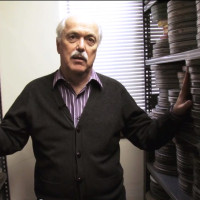
Richard Wright, senior research engineer for archive research at the BBC
Regarding the fortunes of analogue and digital film processes:
I had the splendid opportunity to be at the SEAPAVAA meeting in Ho Chi Minh City two weeks ago [March 12 2012], where I could see the rapid progress in various places in South East Asia and the Pacific, including of course with our hosts the Vietnam Film Institute (VFI). They have acquired two Spirit datacine machines, and were reconsidering whether their next step would be a new conventional film lab, or to put their preservation effort and funding into digitisation.
If they go the digital route for preservation, it leaves the issue of what they will do with existing film (real film) prints. As with many other postings on this site [the AMIA-L listserv], they are facing the decline in film projection equipment – which could be accelerated if the VFI themselves convert to digital projection in their facilities.
I found myself recommending that whatever they do, they should consider maintaining ways to project their existing stock of prints, even if they have no plans to make future prints (or ‘new masters’ or any other film components). In doing so, I was conscious that I was advocating “digital for preservation, real film for access” – which is a total reversal of the standard mantra of “film for preservation, digitisation for access.”
Because of the need for translators, I wasn’t sure if what I was saying was getting across, much less making sense. I’m not sure I’m getting my message across now – but I find it interesting, if no stronger word, that I’m now an advocate of digital for preservation, but “real film” (while the prints and the projectors last) for access – so people in Vietnam, as well as in North American and European art houses and everywhere else for that matter, can continue to experience “real film.”
Lewis Carroll’s Alice in Wonderland has been memorably adapted numerous times, as early as 1903 by Cecil Hepworth and Percy Stow (left).
Throughout April, The Cinefamily, a hearth-warming, Los Angeles familiarizer of film, is presenting versions of the not-just-for-children classic. The selections are excerpted on the organization’s website.
Jan Svankmajer’s 1988 live-action/animation masterpiece of fur, bones, clicks, creaks, and squeaks Alice, “the most gloriously macabre Alice adaptation ever filmed”:
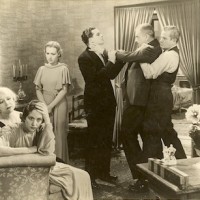
The 1933 Alice in Wonderful that featured W.C. Fields as Humpty Dumpty:
A 1966 version directed by Jonathan Miller, with Anne-Marie Mallik as Alice, and a slew of well-known players in supporting roles, including John Gielgud, Wilfrid Brambell, Peter Cook, Michael Redgrave, Leo McKern, and Peter Sellers, and with music by Ravi Shankar:
You’d think that some weirdo would have made a porn version of the story, by now. Ah, such a version does exist. It’s the 1976 Alice in Wonderland from Bill Osco and the makers of the softcore hit Flesh Gordon, and The Cinefamily is showing it, too.
Didn’t her mother warn her against drinking unidentified substances from found bottles?
Anne-Marie Mallik proceeds to "drink me" in Jonathan Miller's version of 1966.
With the volume of news about moving image archives, film and video restoration, and the like that appears, here and there, you might conclude that the zeitgeist is turning in favor of such undertakings. Perhaps it is. Perhaps little by little awareness is growing of just what could be lost, if efforts are not made.
Lillian and Dorothy Gish in "Orphans of the Storm," 1921
Among efforts that are being made, and that have caught media attention in recent days, are these:
March 29 2012 – The Academy of Motion Picture Arts and Sciences has acquired more than 70,000 photographs from the Bison Archives, the private collection of renowned film historian Marc Wanamaker.
"Le voyage dans la lune," 1902
Old news, now, but good news: Last year, an astonishing restoration of the classic early film, Le Voyage dans la Lune (“A Trip to the Moon”) by Georges Meliès, renowned for its iconic black-and-white images, was screened at the Cannes Film Festival, on the French Riviera. The original, colorized, 1902 version of the film was long thought lost until the early 1990s, when an anonymous donor gave a copy to the Cinematheque de Barcelone, in Spain.
The Hollywood company Technicolor assisted a team led by Serge Bromberg, head of Lobster Films, joined by Fondation Groupama Gan, to revive the movie, whose most iconic image is a fanciful tin-can space capsule against a moon’s-eye backdrop.
Under the lead of NHF’s Karan Sheldon, materials being collected include original 16mm and 8mm film reels produced by members of the Amateur Cinema League (ACL). The league’s president in 1939, wrote to his organization’s members, at the time: “The New York World’s Fair depends upon your camera and your eye to tell other generations that here, in 1939, men and women of good will from all over the earth had the courage to set up a tribute to the ways of peace and the hope of perfection.”
Funding for the project is coming through the Council on Library and Information Resources program, Cataloging Hidden Special Collections and Archives.
Commuters jostle through the Tube in a scene from Underground, 1928. Image: BBC Symphony Orchestra
Thankful for his 26 years as a silent-film composer and accompanist, Neil Brand, director of the British Silent Film Festival, wrote in September 2011 that “one of the greatest privileges for me as a silent film pianist is that I have often been amongst the first to see new restorations of silent films. These miraculous revenants, glowing and unspotted thanks to the care of archives such as the BFI National Archive, place the viewer firmly back in their era.” He illustrates his account with footage from such films as Hitchcock’s The Man Who Knew Too Much with its blackly humorous recreation of the so-called Battle of Stepney which galvanized London in 1911, and was filmed for posterity – and the odd amusement of minds like Hitchcock’s.
What would you put in your wunderkino? A “wonder-cinema” is a collection of moving images that project its maker’s curiosities and personality, as a holiday album of photos and mementos may project the diversion, adventures, and even hints of the lurid that do not quite stay in Vegas, or at the beach, or on that cruise through some straits or other.
In the case of Northeast Historic Film’s annual Summer Symposium, the Wunderkino is an annual presentation – heading towards its teenagehood – about the history, theory, and preservation of amateur and non-commercial films that strike NHF curators, members, and conference-goers as in some sense compelling.
In 2011, the NHF Summer Symposium focused on assembling a “cabinet of cinematic curiosities.” (See MIAN’s article, here.) This year, NHF is inviting proposals that feature “amazing and extraordinary studies of amateur and non-theatrical films that offer lessons about culture, heritage, history, geography, performance, and the drama and comedy of social life.”
The organization’s goal is to feature approaches that scholars, artists, filmmakers, and archivists are bringing to the study and use of amateur and non-theatrical film.
The NHF is now calling for proposals that would feature excerpts as part of their presentations. The presentations will be made at the NHF’s 125-seat cinema with 35mm, 16mm, videotape, and DVD projection.
For over a decade, the NHF Summer Symposium has been a multi-disciplinary gathering that brings together archivists, scholars, and artists for three days of viewing and discussing lesser-known, amateur, and found films.
NHF is located in Bucksport, a Maine coastal town of 5,000 people. Presenters typically have 30-45 minutes in which to deliver their paper and engage in discussion with their colleagues. The symposium is open to archivists, artists, and scholars from all disciplines.
To be considered, send 250-500 word abstracts outlining paper ideas and a brief CV to NHF, by email; details online. Call For Papers Or, contact NHF first to discuss presentation ideas in advance of a formal submission. Send proposals and inquiries to: symposium@wunderkino.org
The Symposium Program Committee will begin reviewing proposals on April 11 2012 and will finalize the program by May 11 2012.