
archives

Archive for July, 2010

Searching East Asian Archives

posted by MIAN on July 28, 2010

East Asian cities have become showcases for some of the most lavish architecture of modern times. They may prompt Western visitors to exclaim: “Is this Asia?” But how are the cities portrayed in cinema?

For the book they recently edited, Cinema at the City’s Edge: Film and Urban Networks in East Asia (University of Washington Press, in cooperation with Hong Kong University Press’s TransAsia: Screen Cultures series), Yomi Braester and his colleague James Tweedie collected essays by scholars of cinema, architecture, and urban studies from Hong Kong, Taiwan, Australia, Canada, the United Kingdom, and the United States.

For anyone interested in exploring archives of films and other moving images from East Asia, Braester offers these thoughts on his own research, in an interview with MIAN:

I did use a number of archives. They included the Beijing Film Archive, which is the only one in possession of some of the materials (for example, Chinese documentaries from the 1960s); the archives of the Shanghai Media Group, which holds many TV programs and video materials used solely for internal Communist Party consumption; the Shanghai and Beijing Municipal archives, which are now thoroughly computerized – they don’t have any moving images as far as I know, but they have much related materials; and the Beijing People’s Art Theater archives, which do include some recordings, although I did not use them. One of the reasons for not relying on the BPAT recordings is that unlike the US or anywhere else I know, videos are widely available on the free market in China. That’s true for film classics as well as theater productions. Another form of archive that may be somewhat special for China is collections of independent films. There are such collections at Shanghai University, Fanhall (in Songzhuang, near Beijing), UC-San Diego, and a few other, smaller places; other foundations have idiosyncratic but marvelous collections, notably the Long Bow Group. People familiar with these circles rarely need to use the formal archives; instead, they get copies from the curators or from the directors (which is what I did). I have a long list of acknowledgments in my book, and it reflects the large amount of help I received from archivists, curators, and other facilitators of archival material.

The steepest learning curve had to do with finding out whom to approach for unofficial materials, and which stores hold the best collections of published VCDs and DVDs. A memorable experience of an obstacle was my attempt to use the archives of the News and Documentary Film Studio. I was ushered into a room, where the archivist was extremely friendly. He explained to me that the materials I was interested in were just across the hall from where we sat. Then he said: “to get into that room, all you need is a letter of recommendation – from a person at the ministerial level.” My connections in Beijing do not extend to national bureau chiefs, so I have never crossed that corridor.

Categories: Shortsblog

Keeping an Eye on Surveillance

posted by MIAN on July 23, 2010

Torin Monahan explores what happens when social anxiety reigns, and surveillance seems to offer a remedy, in his latest book, Surveillance in the Time of Insecurity (Rutgers University Press).

There, the associate professor of human & organizational development and associate professor of medicine at 
Vanderbilt University examines the interplay of insecurity, surveillance, and inequality in modern times, taking as his illustrations such cultural artifacts as Christian “rapture” fiction and films, the blockbuster television show 24, and the rising tide of gated, video-monitored communities and the varied approaches to urban control of the movement of traffic and people.

Here’s what Torin Monahan had to say about the films and footage he used in his study:

I relied on Netflix to assist me with the writing of two chapters of Surveillance in the Time of Insecurity. In one chapter I analyze the counterterrorism-themed show 24 and trace its connections to popular conceptions of risks posed by terrorism. I obtained all the seasons of the show through Netflix and then coordinated my analysis by referencing plot synopses on the show’s website. Additionally, I read numerous stories and reports about the effects of the show upon soldiers in Iraq and Afghanistan and upon members of the Bush administration and other public officials.

In another chapter, I analyze the popular genre of “rapture fiction,” with a focus on the Left Behind series. In addition to accessing the Left Behind books, I also obtained from Netflix the two feature films made about the story. The chapter argues that feelings of insecurity are often used by communities to justify harsh or unequal treatment of people considered to be different. In the narrative of the Left Behind story, belief in the forthcoming destruction of the world is used as a rationalization for excluding others and abdicating responsibility for the greater social good.

In research for another chapter, on intelligent transportation systems (ITS), I also viewed video footage monitored and shared by transportation engineers. Some of the most disturbing of these Internet-shared video files were of car crashes at intersections and of pedestrians being hit by vehicles moving at high speeds. It struck me that these files, which were shared among engineers through email, were pornographic in their gratuitous presentation of violence, so I have opted not to reproduce that violence in my speaking or writing on the topic. However, in the chapter on ITS, I do discuss other video footage monitored and acted upon, mostly in real-time, by transportation engineers and others.

What kinds of challenges, rewards, experiences, or surprises did you have, in the archival part of your project?

The chapter I wrote on 24 simply couldn’t have been written without accessing all the seasons and episodes of that show. Thus, the biggest reward was that the moving-image archive, as such, made possible in-depth analysis of this highly entertaining show.

Viewing the seasons in this way allowed me to take a step back and look for dominant themes and connections among the various plot lines and to draw out – in my writing – the implications of those themes for real-world experiences and politics. One key challenge was coding the shows in such a way that I could readily access quotes or reference particular plot lines. If there were transcripts available of the shows, that would have assisted this process immensely.

There’s not a whole lot to say about the challenges and rewards of viewing the Left Behind films. In the course of the research for this chapter, I was surprised to discover that this campy and roughly made media could attract such a monumental following. That made it all the more imperative, in my mind, to take the works and their potential ramifications seriously.

Left Behind (2000)

Left Behind II: Tribulation Force (2002)

Left Behind III: World at War (2005)

http://www.youtube.com/watch?v=MREYMpWc1Iw&feature=related

Finally, in doing the research for writing the chapter on intelligent transportation systems, I was surprised to find out that transportation engineers were reluctant to comment on – or even acknowledge – the ways in which their collected images and videos circulate (to other engineers, to the media, to the police). Transportation engineers do not see their work as being about “surveillance,” in spite of the fact that some of their activities clearly are surveillant ones. Even if engineers are not engaged in surveillance, however, the systems they oversee allow for the capture and circulation of images and data to other people, some of whom are very interested in monitoring and controlling others.

European Commission Video explaining Intelligent transportation Systems

presented at the American Association of State Highway and Transportation Officials (AASHTO) 2007 Annual Meeting.

Categories: Of Special InterestShortsblog

Can that Laughter

posted by MIAN on July 22, 2010

The Archive of American Television recalls the day that canned laughter began, on the Hank McCune Show
In its online “Daily” feed, The Paris Review has reprinted an interview with Ben Glenn II, a TV historian and expert in the history of canned laughter. It’s from Mike Sacks’ book, from last year, And Here’s the Kicker: Conversations with 21 Top Humor Writers on their Craft (Writers Digest Press).
The interview will do little to appease anyone who realizes that canned laughter is an abomination – well, arguably – but it does put the practice into perspective. It may perhaps even make you wish you had a laugh track for your own humor among friends.

Glenn describes the beginnings of the laugh track on television, after limited use in radio. “Its first TV appearance was in 1950, on a rather obscure NBC situation comedy, The Hank McCune Show,” he says.

Glenn explains producers’ motivations for using the device – it facilitated shooting outside and on location, and of course it also provided laughs where there were none, sometimes because who laughs at the fifth take?

Another, less common motivator was that some programming provoked live audiences “to laugh too long” – seems an odd euphemism for “to laugh genuinely,” but there you have it. The most renowned instance of that occurred on an I Love Lucy show: the March 1957 “Lucy Does the Tango” sequence where Lucy dances the tango with raw eggs stuffed into her shirt – the mishap that ensues provoked a 65-second chuckle.

Much of the interview relates how Charles Rolland Douglass invented the “Laff Box,” a tape-loop device that he wheeled around on a dolly and locked up at night, to guard its secrets. Glenn also describes the uncanny skill Douglass had in storing, manipulating, and deploying laughter from various sources – Douglass was able, for example, to recall and reuse particular snatches of laughter, sometimes many years later, according to his needs for guffaws, titters, or other varieties of genuine response.

Some of Douglass’s earliest canned laughs came from a Marcel Marceau performance in Los Angeles in 1955 or 1956, during his world premiere North American tour, while others are believed to have come from The Red Skelton Show, Glenn says, although he adds that many of the secrets of Douglass’s methods went to his grave with him in 2003, and have remained well kept by his heirs and colleagues, even now that other companies have long been in the market, supplying chuckles via computerized programs.

Douglass’s company, Northridge Electronics, now run by his son, Robert Douglass, still produces most of TV’s canned laughter.

Among the most interesting notes of the interview are Glenn’s discussion of how canned laughs have changed, over time. For example, he told Sacks that in the 1960s “you could hear more individual responses – chortles, cackles from both men and women.”

He added: “Laughs are now much less aggressive and more subdued; you no longer hear unbridled belly laughs or guffaws. It’s ‘intelligent’ laughter – more genteel, more sophisticated. But definitely not as much fun.”

For his contributions, the Academy of Television Arts & Sciences awarded Douglass a 1992 Emmy for lifetime technical achievement.

Categories: Of Special InterestShortsblog

The Surprising History of the Hindi Action Film

posted by MIAN on July 20, 2010

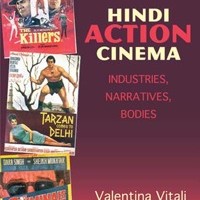
Ever wonder where the stylizations of Bollywood films come from? Turns out that song, dance, and all the fanfare were features of the very first Indian sound film, Alam Ara, from 1931. Just as compelling is to learn that its star, Master Vithal, was a descendant of a long line of Hindi action-film stars, dating from the 1920s. The University of East London’s Valentina Vitali relates the fascinating story of those early days of Indian film in her book, Hindi Action Cinema: Industries, Narratives, Bodies, released in the UK by Oxford University Press in 2008 and now issued in the US by Indiana University Press.

This item is from our constantly updated book pages, in which we often include reports from authors about how they went about getting access to films relevant to their studies.

In Hindi Action Cinema, Vitali, who earlier co-edited Theorising National Cinema (British Film Institute, 2006), recounts the history of Bombay action films and investigates how the socioeconomic circumstances of their audiences fueled the prominence and marketability of action. She considers such factors as the popularity of stunt films in the 1920s; the role of women in action films from the mid-1920s to the end of the 1930s; and socioeconomic factors in the popularity of such fascinating figures as Master Vithal, Ermeline (the Jewish Indian actress known as India’s Clara Bow), the Australian-born Fearless Nadia, Dara Singh, and Amitabh Bachchan, as well as other, more contemporary figures.

Rachel Dwyer, University of London, calls the book “pioneering in its study of the importance of exhibition and distribution to the Hindi film industry.”

d

Master Vithal in a scene from Alam Ara (1931), directed by Ardeshir Irani, the first sound film in Indian cinema, a torrid tale of a love triangle that went as badly as some do. Wikimedia Commons

Categories: blog